
How to Play Dragon Ball Super Divers: Rules and Card Teams
Avatar and Battle Card teams, three-area layout, Strike Battles, battle types, and Diver Passport modes for Dragon Ball Super Divers. Open the rules guide.
How to play Dragon Ball Super Divers starts with a physical deck, not a controller. You register one Avatar Card that holds your diver profile, then slot one to seven Battle Cards into three touchscreen areas. Each round you choose which cards attack, which cards support, and when to commit. Combat power decides who strikes first; timed button phases called Strike Battles decide ki damage, faint status, and HP loss. This page explains the stable rules as of Set 12, with notes where Set 13 scheduled for November 19, 2026 adds new area types covered in our Strike Battle and BUPPA guide.
What do you bring to the cabinet?
Your registered team is always one Avatar Card plus one to seven Battle Cards (eight physical slots maximum, but only seven fighters). Sum every Battle Card’s HP value to get Team HP; when that pool hits zero, you lose the match.
If you own fewer Battle Cards than a mode expects, the machine can inject virtual cards so the battle still runs. Virtual fillers let tourists try a stage without a full collection, but they are not collectible prints. For your first visit, read the beginner guide on Trial Diver Passport limits before you build expectations about ranked play.
How do the three areas and zones work?
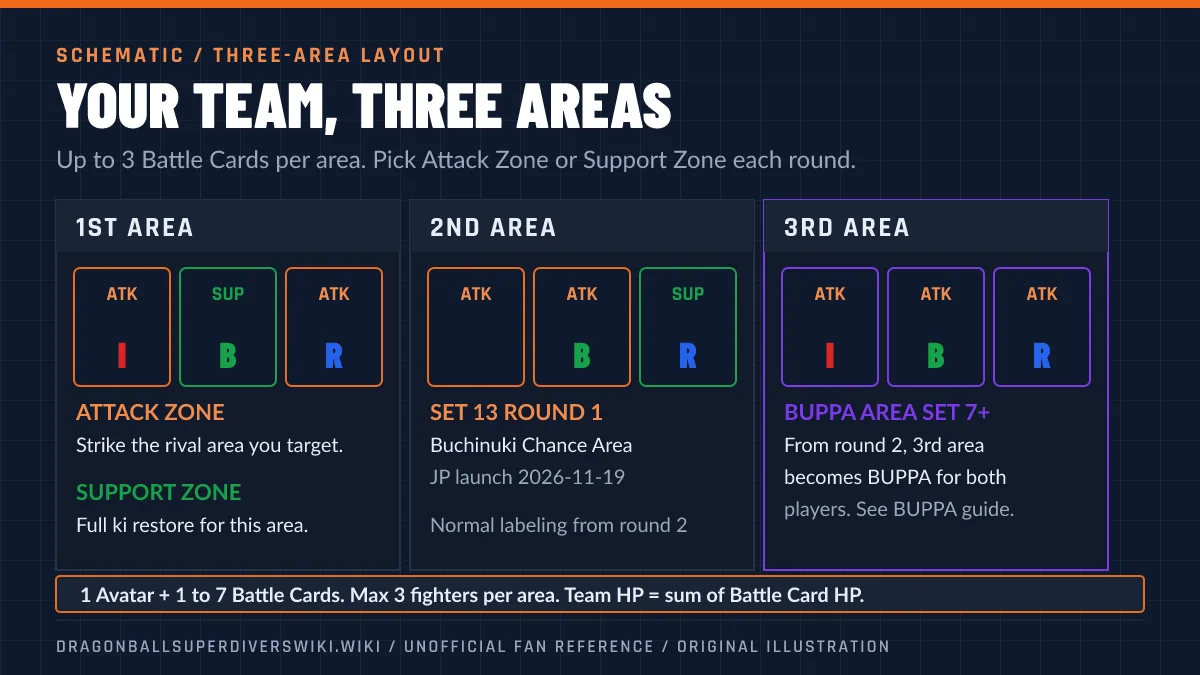
Official rules split your side into 1st, 2nd, and 3rd area. Each area accepts up to three Battle Cards on the touch layout. Before combat resolves you assign roles:
- Attack Zone cards strike the opposing area you target.
- Support Zone cards fully restore ki for that area.
After both players confirm, the cabinet compares combat power (official wording on the Japanese rule pages). The higher total earns initiative, and strikes begin from the initiative player’s 1st area in the documented order. Every area participates: each area’s attack side and defense side each fight one Strike Battle per round unless a mode shortcut says otherwise.
From Set 7 onward the 3rd area becomes a BUPPA area starting round two. From Set 13’s Japan launch (scheduled November 19, 2026) round one’s 2nd area becomes a Buchinuki Chance Area. Those labels change rewards but not the three-card cap. The round-by-round map lives in strike-battle-and-buppa-explained.
What happens during a round?
The loop is placement, commitment, initiative, then strikes. Conceptually:
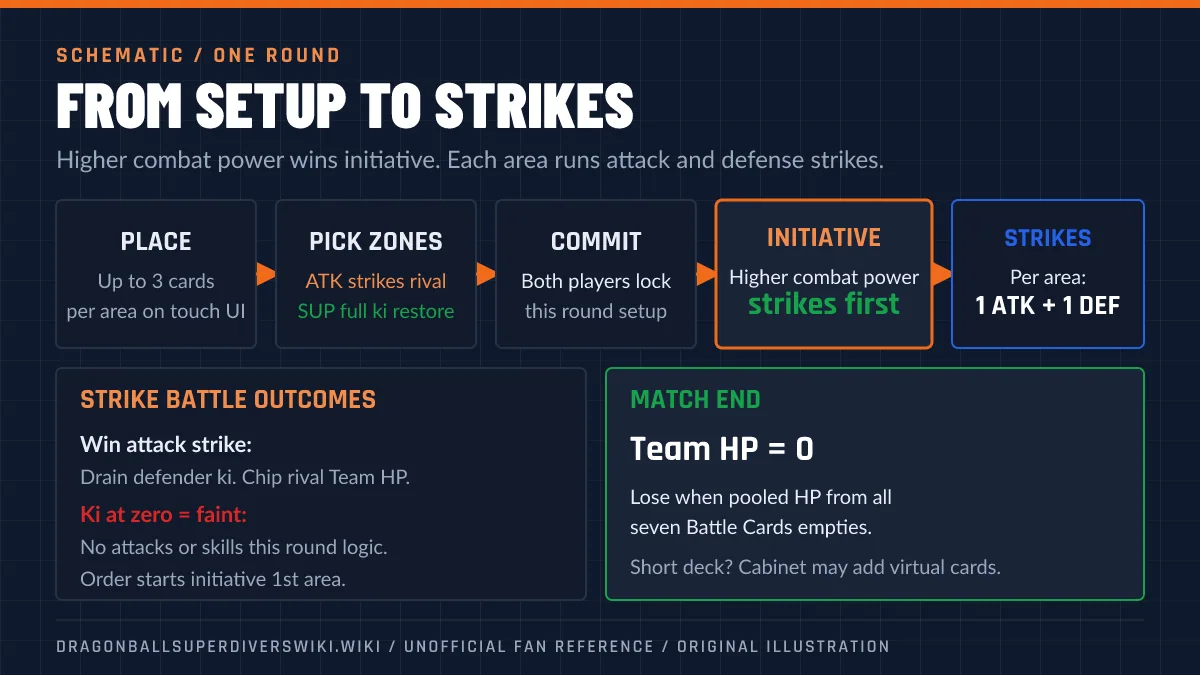
Each Strike Battle is a timed button contest between the attacking and defending cards in that area. Win the attacker’s Strike Battle and you shave the defender’s ki; ki at zero means faint. Fainted cards cannot attack and their skills do not fire. If every defending card in an area is fainted, the attacker’s follow-up damage to that area uses a 1.5x multiplier on the official rule sheet.
Special moves need enough combined special move energy in the area and a won attack Strike Battle, except inside BUPPA areas where different bypass rules apply once Set 7 cards are legal in your shop. Full timing detail is in the dedicated Strike Battle page, not repeated here.
What do the numbers on a Battle Card mean?
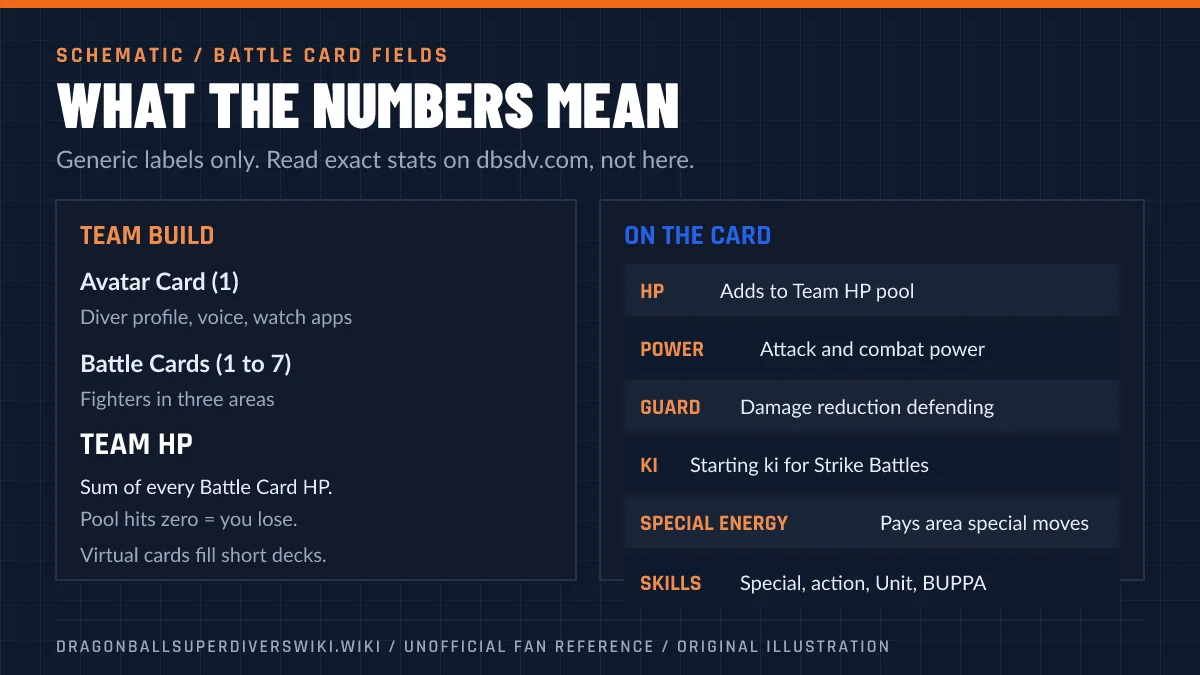
Cards print several combat fields. You do not need Japanese to recognize the icons after one match:
| Field | Role in battle |
|---|---|
| HP | Adds to your Team HP pool |
| Power | Feeds attack strength and combat power comparisons |
| Guard | Reduces damage taken while defending |
| Initial ki | Starting ki stock for Strike Battles in that area |
| Special move energy | Pools with allies in the same area to pay specials |
| Skills | Special moves, action skills, Unit Skills, and (from Set 7) BUPPA Skills |
Bandai hosts searchable stats on dbsdv.com; we do not copy numeric tables into this wiki. For rarity icons and pull notes, see rarity guide.
What are the four battle types (I / B / R / L)?
Type icons are single letters on the card frame:
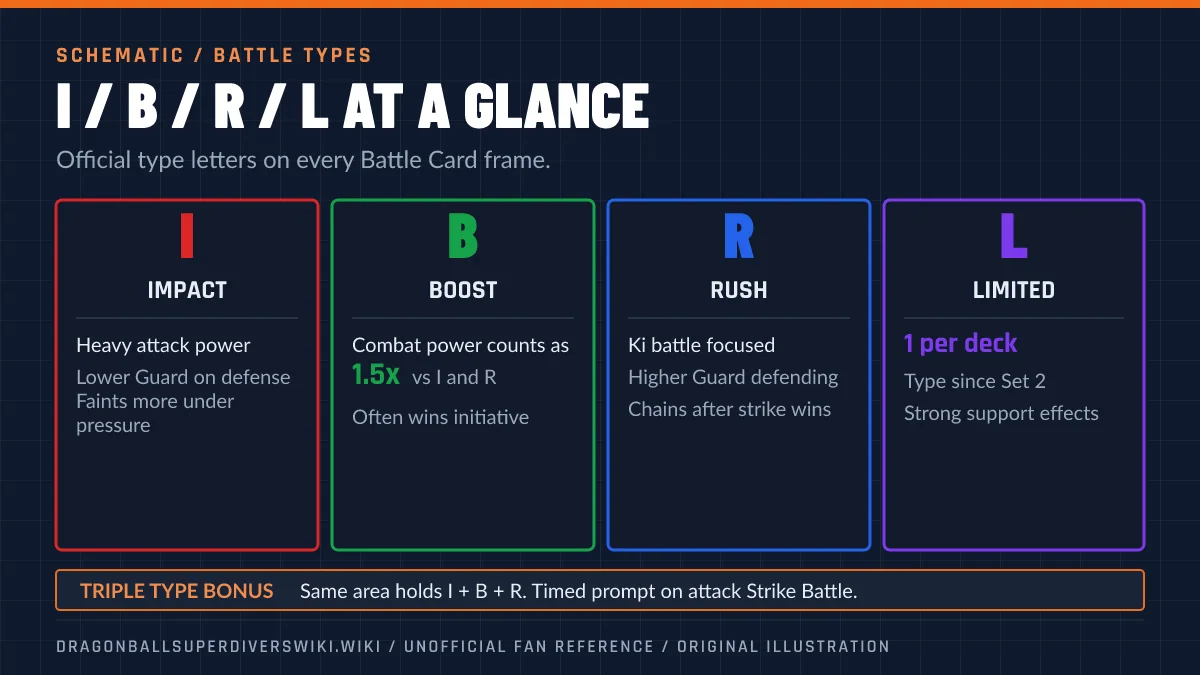
- I (Impact) hits hard but tends toward lower Guard and weaker ki damage resistance while defending, so Impact attackers faint more easily under pressure.
- B (Boost) counts combat power at 1.5x the value of Impact and Rush for initiative math, making Boost cards common init winners.
- R (Rush) focuses on ki battles, higher Guard on defense, and follow-up chains when you win strikes.
- L (Limited) is restricted to one copy per deck (type introduced in Set 2) and usually carries a strong support or rule-bending effect.
If one area holds Impact, Boost, and Rush together, you can trigger Triple Type Bonus by hitting timed prompts during an attack Strike Battle. In BUPPA areas from round two onward, that bonus auto-succeeds per Set 7 rules.
Which modes can you select after paying 100 yen?
Modes are separate from the core combat loop. Official Japanese names map roughly as follows (unofficial translation on first mention):
| Mode (unofficial translation) | What it is for |
|---|---|
| Super Dokabaki Dive | Main progression route through arcade stages |
| History Dive | Story scenes from the franchise, expanded each set |
| Challenge Dive | High difficulty “Super God” stages with time windows |
| Strike Battle Rush | Simplified seven-opponent gauntlet ignoring most card text |
| Ranked Match | Ladder with daily 10:00-23:59 JST window when season is open |
| Casual Match | Unranked online fights |
| Friend / in-store match | Local or friend code battles on full Passport |
| Heroes Mode | Legacy Dragon Ball Heroes content since 2024-11-11 |
| Purchase Cards | Pay without battling to dispense a card |
Ranked uses the Bronze-to-God ladder with listed point thresholds on the official site. Casual Match is separate from Ranked and does not change rank or streak counters. Trial Diver Passport cannot enter Ranked, Casual, Friend, in-store battles, or team events, cannot build or join saved teams, and allows only one avatar with up to 30 saved sessions; upgrade or transfer to a full Diver Passport or compatible Amusement IC Card for those features.
How does this game relate to the product overview page?
If you are still deciding whether to travel for cabinets, read what Super Divers is for Japan-only availability and machine counts. Collectors staying home should pair this rules primer with Advance Packs and the glossary for menu kanji. Set release order is indexed on release timeline.
Sources and verification
Last verified: November 11, 2026. Built from Bandai’s official Super Divers pages (guide, about rules, news) and rewritten in our own words. English names marked “unofficial translation” are ours, not Bandai’s. This is an independent fan reference, not affiliated with BANDAI NAMCO, Dimps or Toei Animation.
FAQ
How many cards are in a team?
What is an Avatar Card?
What is a Diver Passport?
When is online Ranked open?
Related Articles
decks
Dragon Ball Super Divers Set 12 Tier List (2026 Update)
Bandai does not publish a Super Divers tier list. We cite dbfw-days' Set 12 top five and explain why solo card ranks rarely match your deck. Read before you buy.
guides
Dragon Ball Super Divers Advance Packs and Retail Products
Japan-only Advance Packs use retail pools separate from arcade drops. English news confirms three cards per sealed pack—filter Bandai's official cardlist. Open here.
guides
Dragon Ball Super Divers Beginner Guide for First Arcade Visit
Japan arcade first visit: Trial vs Diver Passport, 100 yen plays, team limits, modes you can access, and honest answers on English support. Pack your visit.
Was this helpful?
Thanks for the feedback!