
Dragon Ball Super Divers Rarity Guide: SEC and GDR (2026)
Bandai does not publish Super Divers pull rates. SEC, GDR, PUR, SR, R, N, EXR, PR, CP and star Alt-Art explained with Set 12 counts. Read the ladder now.
Dragon Ball Super Divers uses a stack of printed rarity codes on every Battle Card and Avatar Card. Collectors search for pull rates, SEC pulls and god rare cards, but Bandai has not published drop-rate percentages for arcade cabinets or retail packs. What you can trust are the official English names, the structure of each set list, and the rule that higher rarity usually means stronger stats or skills.
What are the official rarity names in English?
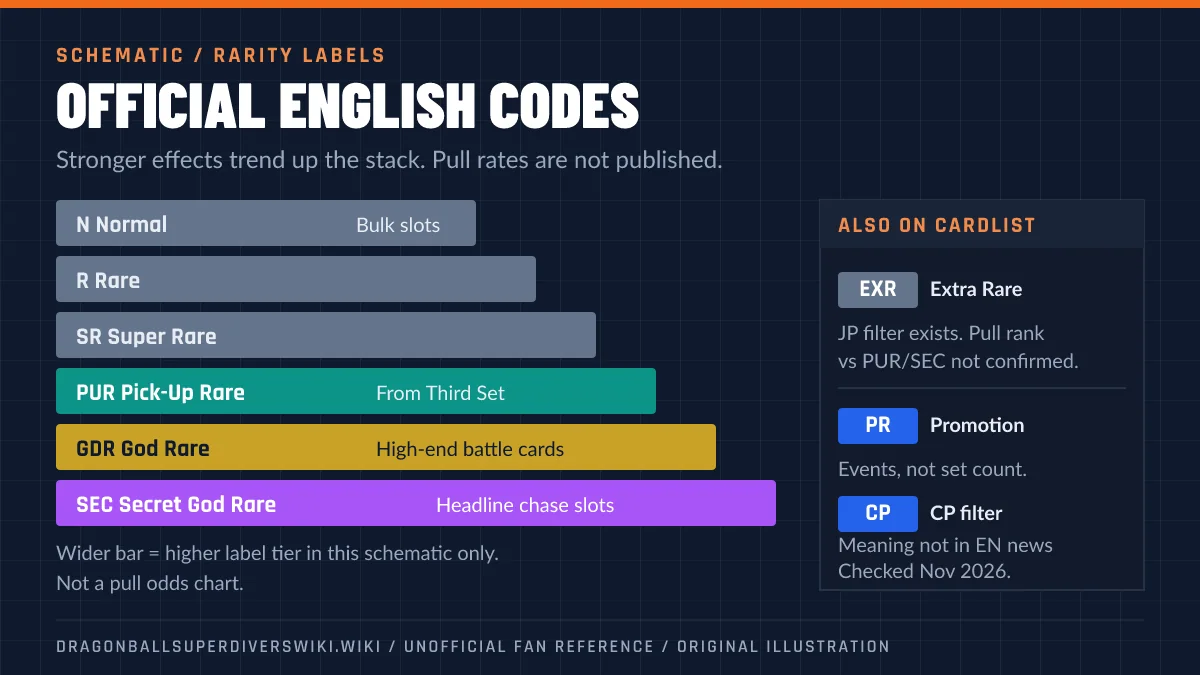
Bandai’s English news posts spell out these abbreviations:
| Code | Official English name | Notes |
|---|---|---|
| N | Normal | Base bulk in set lists |
| R | Rare | — |
| SR | Super Rare | — |
| GDR | God Rare | High-end battle cards |
| SEC | Secret God Rare | Usually two headline cards per set |
| PUR | Pick-Up Rare | Present from Third Set onward |
| EXR | Extra Rare | Listed on the Japanese cardlist filter |
Promotion cards use PR in the cardlist filter. A separate CP filter also appears there; Bandai does not spell out that abbreviation in the English news we checked, so treat CP as an official list category without guessing its meaning.
The Japanese how to play guide explains, in Japanese, that higher レアリティ tends to mean higher card power or stronger abilities, and that some cards ship parallel illustrations. That matches the English news tone on SEC and GDR cards.
For a full Japanese-to-English label crosswalk while shopping, see the glossary of JP and EN terms.
Does Bandai publish pull rates for rare cards?
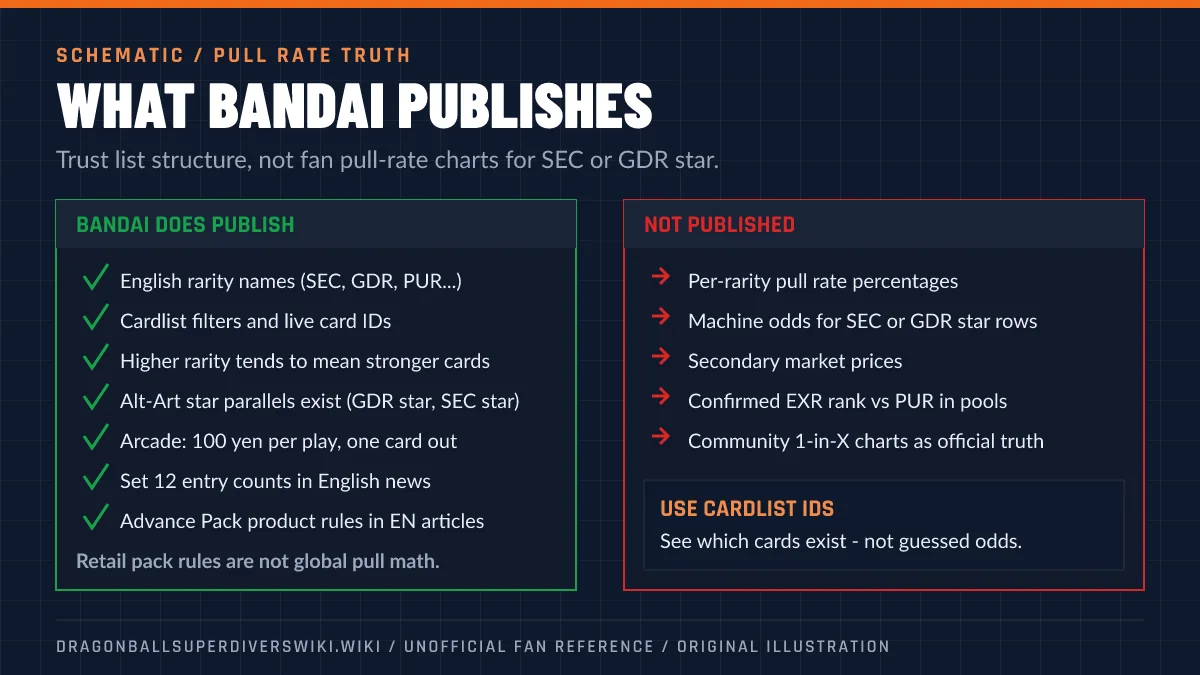
No. Neither the Japanese site nor English news posts give a table of odds for SEC, GDR star, PUR or SR pulls from the ¥100-per-play cabinet. Retail Advance Packs guarantee product rules in English articles (for example three random cards per pack, or all R or higher in Battle of Saiyans packs), but those statements are not the same as global pull-rate math across the whole game.
If you are hunting rare cards for a binder, focus on card numbers and star parallels, then read how to buy cards from outside Japan for sourcing. Gameplay value for competitive lists is covered separately on the Set 12 tier list.
How does Set 12 Innate Attack illustrate rarity volume?
Set 12 launched in Japan on 2026-09-17 according to English official news. The public list structure, without copying the full card table, looks like this:
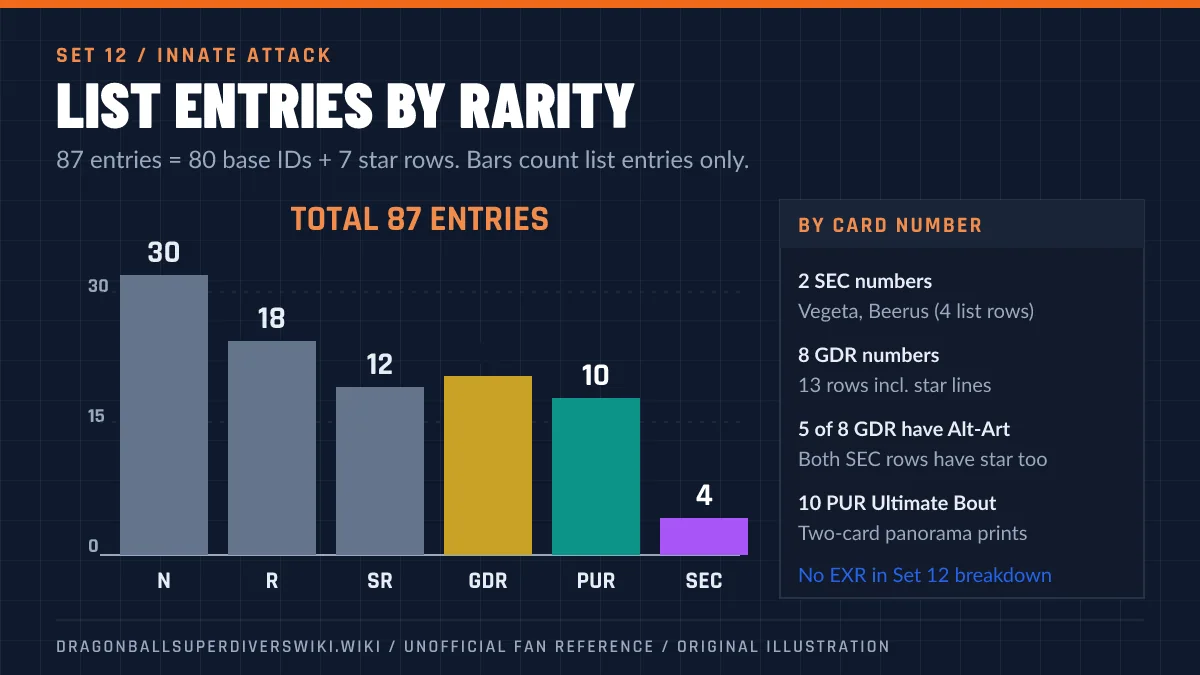
- 87 list entries total: 80 base card numbers plus 7 star parallel rows that share an ID with a base card.
- By entry count: N 30, R 18, SR 12, GDR 13, PUR 10, SEC 4.
- By card number: 2 SEC slots (Vegeta, Beerus) and 8 GDR numbers, with English news stating that five of the eight GDR cards have Alt-Art (GDR star) versions and that both SEC cards have SEC star parallels.
- 10 PUR cards use the “Ultimate Bout” theme, with art spanning two cards to form one image, and each card referencing an action skill or BUPPA skill from Sets 7 through 11.
Set 12 does not add EXR rows in the published breakdown above. Always cross-check live data on the official cardlist because campaign promos can sit outside the main set grid.
Card-specific write-ups such as SDV12 SEC Vegeta and SDV12 GDR Turles drill into individual chase slots. The Set 12 hub tracks launch context.
What are star Alt-Art parallels (GDR star and SEC star)?
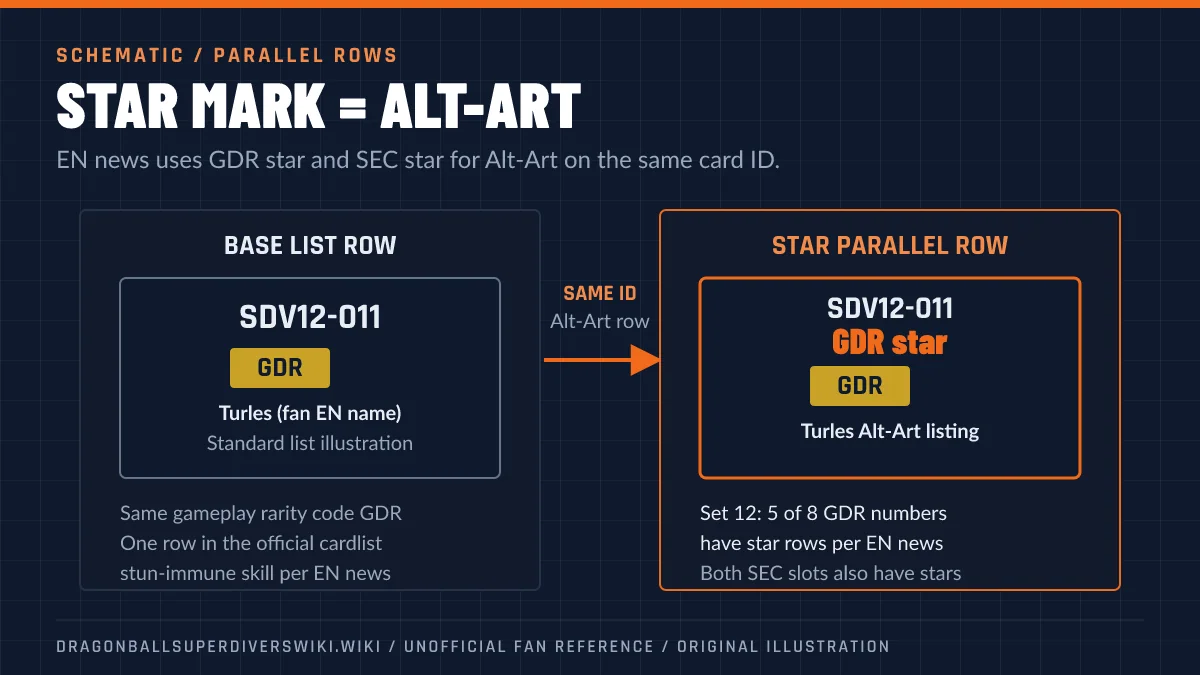
Alt-Art parallels keep the same SDV card number but swap the illustration. Official English news calls them Alt-Art versions and uses a star marker in prose (for example SEC star on Vegeta and Beerus, GDR star on five GDR slots in Set 12). The Japanese guide calls them パラレルカード with different art.
Collectors often treat star parallels as the real god rare or sec chase pieces even though the gameplay rarity code on the card may still read GDR or SEC. When a seller listing says “star” or shows a star in the title, compare photos to the base version and confirm the ID on the official list.
PUR cards can also have special print treatments (Set 12’s two-card panorama is an example), which is separate from the GDR/SEC star system.
Where does Extra Rare (EXR) fit?
Extra Rare (EXR) shows up as its own checkbox on the Japanese cardlist and in the rarity carousel on about.php alongside GDR, SR, R, N, PUR, and SEC examples. That confirms the label exists in the live database.
What Bandai does not publish is a definitive ladder that ranks EXR against PUR or SEC for pull difficulty. The carousel order on the beginner page is an teaching UI, not an odds chart. Until Bandai states otherwise, this wiki lists EXR as a real category but does not claim it is “above SR” or “below PUR” in machine pools.
How do PR and CP marks work?
PR (promotion) cards come from events, magazines, location tests and giveaways. They are filtered separately on the cardlist and often carry unique IDs such as SDVP promos. They are not part of the main N-through-SEC set count.
CP appears as another rarity filter on the same cardlist page. We could not find an English glossary line defining CP during this verification pass, so do not assume CP means the same thing as PR. Use the official entry for each card rather than seller shorthand.
How does rarity connect to arcade play?
Each ¥100 play (tax included) from the cabinet dispenses one physical card, stated in English reveal coverage and on the Japanese beginner page. Rarity only describes which pool a card belongs to, not how often your next play hits SEC.
Retail Advance Packs pull from their own product pools listed under 収録商品 on the cardlist. Buying packs does not change official odds for machine play.
How should overseas collectors use this guide?
Read rarity codes before you shop so listings make sense. Match every purchase to an ID on the official list, note whether the seller claims a star parallel, and read the outside-Japan buying guide for channel risks. If you also play digitally in Japan, pair this page with how to play and Strike Battle and BUPPA.
Set 13 Awakened Resolve is scheduled for 2026-11-19; its full public list was still pending on 2026-11-11. Expect new labels only if Bandai adds them on the official site, not from leaks.
Sources and verification
Last verified: November 11, 2026. Built from Bandai’s official Super Divers pages (guide, cardlist, news), English news (Innate Attack, game overview), and rewritten in our own words. English names marked “unofficial translation” are ours, not Bandai’s. This is an independent fan reference, not affiliated with BANDAI NAMCO, Dimps or Toei Animation.
FAQ
Does Bandai publish Dragon Ball Super Divers pull rates?
What is the difference between GDR and SEC?
When did Pick-Up Rare (PUR) start?
What does the star mean on a card number?
Where is Extra Rare (EXR) in the lineup?
Related Articles
cards
Dragon Ball Super Divers: SDV12-011 Turles God Rare
SDV12-011 Turles is Set 12 God Rare; English news cites three effects including battle-start stun immunity. GDR star ranks #1 on dbfw-days—see the profile.
cards
Dragon Ball Super Divers: SDV12-SEC Vegeta Profile
SDV12-SEC Vegeta is Set 12's Secret God Rare with Alt-Art SEC star. Skill policy, stats boundaries, and dbfw-days rank #2 for overseas fans. Open the profile.
cards
Dragon Ball Super Divers: SDV12-SEC2 Beerus Profile
SDV12-SEC2 Beerus lowers enemy attackers' Power per Bandai's English Set 12 news. Alt-Art SEC2 star, stats policy, and dbfw-days rank #4. Read the profile.
Was this helpful?
Thanks for the feedback!